




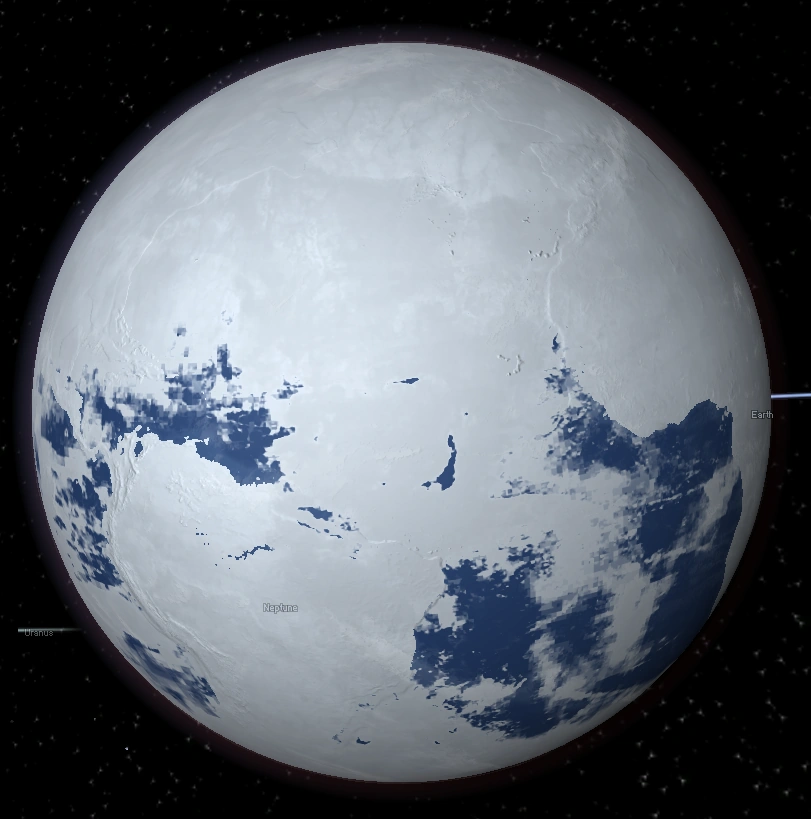
Snowball Earth refers to one or more ancient episodes in Earth’s deep geological past when the planet’s surface was almost entirely covered in ice, stretching even into equatorial regions. These hypothesized global glaciations occurred hundreds of millions of years ago during the Proterozoic Eon, long before complex life became abundant.
The idea is that during these periods, ice sheets expanded so widely that they reflected sunlight, cooling the planet further in a feedback loop that trapped Earth in a deep freeze. Scientists call this a global glaciation or Snowball Earth state.
This concept, first proposed decades ago, has resurfaced in scientific discussion and media because of new evidence, better climate models, and renewed efforts to understand Earth’s climate history.
According to recent scientific work, rocks and geological formations from places that today lie on the tropics show signs of having formed under glacial ice. This paradox is one of the strongest indicators that Earth may once have been fully frozen over.
Why Is It Suddeny Relevant Now
Several factors explain why Snowball Earth is suddenly in the spotlight:
New Scientific Techniques and Evidence
Advances in geology, paleoclimatology and geochemistry have provided fresh data that strengthens the case for ancient global glaciations. Researchers now have better tools to date rocks and interpret ancient climate signals. These methods allow scientists to reconstruct Earth’s climate more accurately than ever before.
Climate Change and Planetary Tipping Points
In an era of rapid climate change, extremes are no longer abstract. Heat waves, melting ice caps, sea-level rise and unexpected weather anomalies make people and policymakers pay attention to historical climate events. Scientists study Snowball Earth partly because it represents an extreme climate state and offers lessons about how Earth’s climate system can shift dramatically under certain conditions.
Understanding Earth’s Resilience and Recovery
One of the most interesting questions is not just how Earth froze, but how it thawed again. The recovery from a Snowball Earth state may have involved increases in atmospheric carbon dioxide, changes in ocean chemistry and even bursts of biological evolution. These processes help scientists understand Earth’s capacity to rebound from severe climate stress.
Life’s Deep History and Oxygen Levels
The timing of Snowball Earth overlaps with major transitions in the history of life, including changes in oxygen levels and the rise of multicellular organisms. Studying these connections helps scientists learn how life and the environment influenced each other over geological time scales.
Why Common People Should Care
At first glance, Snowball Earth might seem like an obscure topic in deep time. But it has real relevance today because:
It Shows That Earth’s Climate Can Tip Into Extreme States
While current human-induced climate change is a warming phenomenon, Snowball Earth reminds us that Earth’s climate system has natural thresholds. Understanding these thresholds helps scientists predict future risks and stability.
It Encourages Long-Term Thinking
Climate discussions often focus on decades or centuries, but geological events span millions of years. Snowball Earth shows that climate is not static, and small changes can lead to big outcomes under certain conditions.
It Helps Us Understand Planetary Habitability
Earth remains the only known planet with abundant life because its climate and atmosphere have remained in a habitable range for billions of years. Studying past extremes like global glaciations teaches us what makes Earth uniquely resilient, and what conditions may threaten habitability elsewhere or in the future.
It Connects Science to Everyday Issues
The public conversation about climate change, sustainability and environmental stewardship becomes more grounded when we understand the history of our planet. Snowball Earth is part of that story, helping people connect deep time science with present-day concerns.
The Broader Scientific Picture
Scientists do not unanimously agree on every detail of Snowball Earth. Some believe Earth was completely frozen, while others suggest a “slushball” state with partial ice coverage. What matters most is that Earth’s climate system is capable of extremes, and learning about these extremes improves our understanding of how climate works.
Studying ancient climates does more than feed curiosity, it builds the foundation of climate science that informs policy, conservation and global cooperation.
Conclusion
Snowball Earth may sound like a relic from a storybook past, but it has emerged as a key concept in modern climate research. Its sudden relevance stems from new scientific evidence, advances in technology, and an urgent global conversation about climate stability. For ordinary readers, it offers a reminder that Earth’s history holds lessons for our future, and that understanding our planet’s extreme states can help humanity protect the one world we call home.