





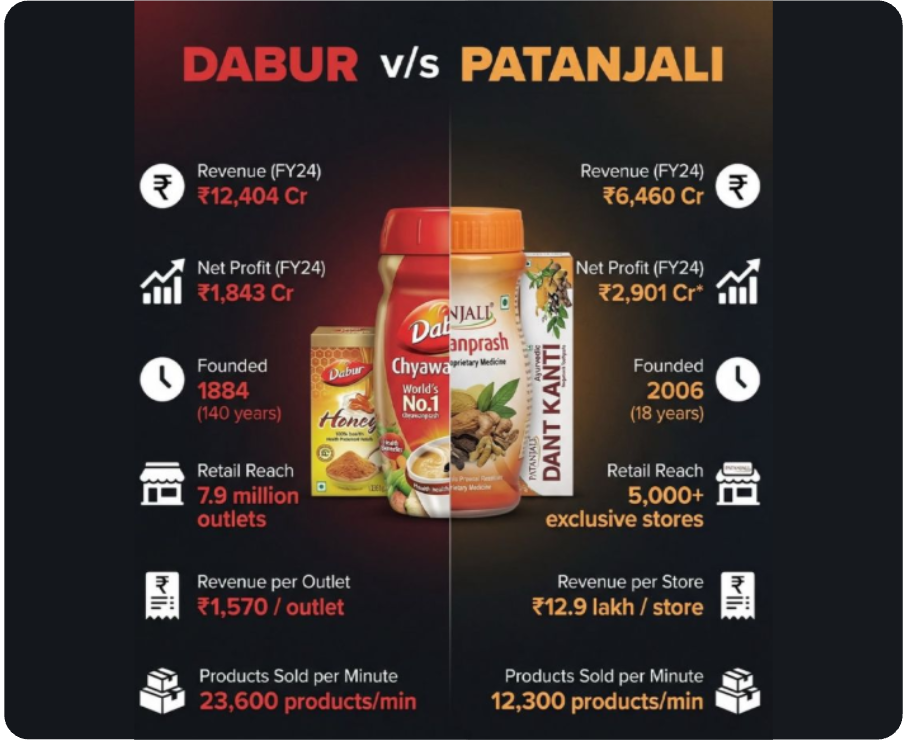
The Indian consumer goods market is witnessing a unique rivalry. It is a contest between Dabur, a brand that has served generations since the British Raj, and Patanjali, the yoga-inspired disruptor that redefined modern marketing. While both dominate the natural health segment, their financial health and distribution strategies tell two very different stories.
The Financial Snapshot
Dabur remains the king of the top line. With a revenue of 12,404 crore rupees, it is nearly double the size of Patanjali’s 6,460 crore rupees. However, the profit story is where things get interesting. Patanjali reported a net profit of 2,901 crore rupees, which is significantly higher than Dabur’s 1,843 crore rupees despite Patanjali having half the revenue. This suggests a highly lean operational model or a business mix that prioritizes high-margin products.
Distribution: Depth vs. Exclusivity
The most striking contrast lies in how these products reach your home. Dabur operates on a traditional model, boasting a massive footprint of 7.9 million outlets. Whether it is a high-end supermarket or a tiny rural shop, you will find Dabur Honey or Chyawanprash. This wide net leads to a revenue of 1,570 rupees per outlet.
Patanjali relies heavily on its 5,000 plus exclusive stores. While its reach is narrower, its revenue per store is a staggering 12.9 lakh rupees. While Dabur is everywhere, Patanjali has turned its locations into destination hubs for loyalists.
Efficiency and Volume
Dabur’s 140 year old trust factor gives it a clear volume advantage. It moves products at an incredible scale, selling 23,600 units every single minute. Patanjali is no slouch but moves about half that volume at 12,300 products per minute.
Dabur is the marathon runner: steady, ubiquitous, and deeply integrated into the fabric of Indian life. Patanjali is the sprinter: young, aggressive, and highly efficient at extracting value from its dedicated retail spaces. As the market evolves, the real winner will be the one who can best balance that legacy trust with modern efficiency.


Post a comment


Threads Overtakes X in Daily Mobile User Rankings!
New data shows Meta’s Threads now surpasses Elon Musk’s X in daily mobile active users,...
Kanwal Rekhi Says Profitability Shows Startup Efficiency!
Veteran investor Kanwal Rekhi argues startups must focus on profitability as a true measure of...
Chtrbox Goes Global, Picks Dubai as First Hub!
India’s publicly listed creator-economy firm Chtrbox launches its first international market in Dubai, aiming to...
IITian Faced 17 Failures, Built ₹40,000 Crore ShareChat!
Ankush Sachdeva turned 17 startup failures into lessons and co-founded ShareChat — a regional social...