




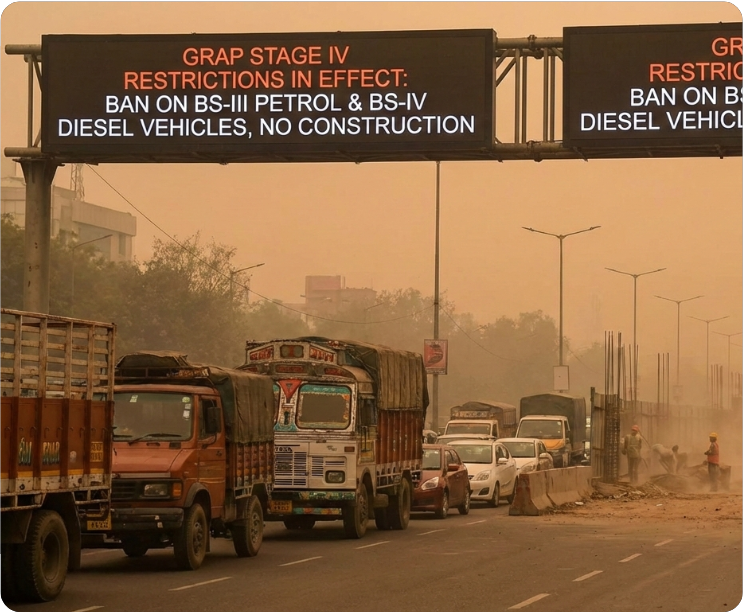
The Graded Response Action Plan (GRAP) has often been criticised for disrupting daily life in Delhi from construction bans to vehicle restrictions. Yet, studies and expert assessments consistently show that these measures are not arbitrary. They are essential interventions to prevent air quality from slipping into life-threatening territory.
How GRAP Actually Helps
1. Prevents extreme pollution episodes
Research suggests that without GRAP, Delhi would face nearly 60% more hours of “severe” AQI and 60–200% more hours of “severe-plus” pollution. In simple terms, GRAP acts as a brake when pollution is about to spiral out of control.
2. Reduces PM2.5 concentrations
GRAP targets PM2.5 which is the most harmful fine particulate matter linked to respiratory and cardiovascular diseases. Depending on the stage, interventions have been shown to meaningfully reduce PM2.5 levels, helping flatten sharp AQI spikes rather than allowing sudden, dangerous surges.
3. Delivers measurable public health benefits
Experts highlight that these reductions are not just statistical improvements. By cutting short-term exposure to toxic air, GRAP can prevent hundreds of premature deaths and save thousands of life-years, particularly among children, the elderly, and those with existing health conditions.
4. Shifts policy from reactive to proactive
Recent decisions such as making Pollution Under Control (PUC) certificates mandatory for refuelling and restricting non-BS6 out-of-state vehicles during high-pollution periods signal a move toward year-round emission control, rather than last-minute emergency responses.
Where GRAP Falls Short
Enforcement gaps
Non-compliance remains a serious issue. Instances like private buses ignoring GRAP norms dilute the effectiveness of otherwise well-designed measures.
Multiple pollution sources
Delhi’s air pollution is driven by a complex mix: vehicular emissions, construction dust, industrial activity, and weather patterns. GRAP alone cannot address all of these simultaneously.
Public inconvenience and economic impact
Construction bans and mobility restrictions can disrupt livelihoods, especially for migrant workers and daily wage earners. This has intensified calls for long-term structural solutions that balance public health with economic stability.
The Bottom Line
GRAP works, not as a permanent cure, but as a critical emergency framework. It prevents the worst pollution spikes and buys time. However, lasting improvement in air quality will depend on sustained structural reforms that go beyond seasonal restrictions.

Post a comment