





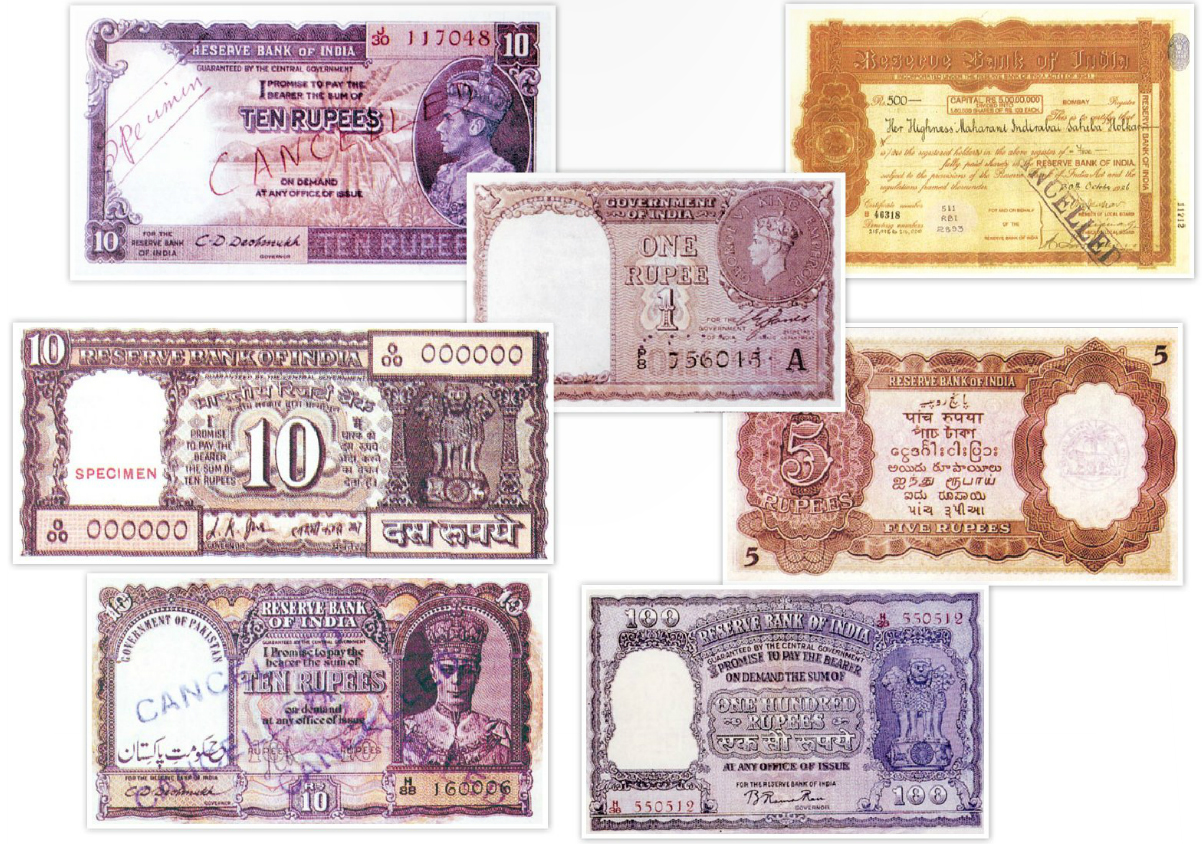
Before 1947, India was under British rule and its currency reflected the colonial era, including images of British monarchs such as King George V and King George VI on notes. These designs were imported or influenced by British standards. After India gained independence on 15 August 1947, the immediate concern was currency continuity, so existing notes continued to circulate but with plans for new designs underway.
The Reserve Bank of India (RBI) continued issuing banknotes from colonial stocks for a few years.
In 1949, India introduced its own design for the Re 1 note, replacing the British monarch’s image with the Lion Capital of Ashoka Pillar, a symbol of the Republic of India. In the early decades of the republic, banknotes often carried national symbols, cultural motifs, agricultural and developmental references instead of portraits. This decision was influenced by a desire to reflect the new nation’s identity rather than individual figures.
Mahatma Gandhi’s First Appearance in 1969
Although it might seem obvious in retrospect, Mahatma Gandhi’s image did not appear on Indian currency immediately after independence. He was first printed on a special commemorative banknote in 1969, on the occasion of his 100th birth anniversary on 2 October 1969. This was a limited-edition Rs 100 note, featuring Gandhi seated with the backdrop of Sevagram Ashram. It was issued in tribute to his legacy and not as part of standard currency circulation.
Making Gandhi a Permanent Feature Since 1996
The major shift came in 1996, when the Reserve Bank of India introduced the Mahatma Gandhi Series of banknotes. This marked the first time that Gandhi’s portrait became a permanent and consistent feature on all denominations of Indian currency. The new series replaced earlier notes that carried symbols like the Ashoka Pillar on the watermark but did not feature human portraits. From 1996 onwards, denominations from Rs 5 to Rs 1000 carried his portrait as a defining design element.
Since then, even after demonetisation and redesigns (for example, the Mahatma Gandhi New Series introduced in 2016 with updated security features and denominations like Rs 2000), Gandhi’s portrait has remained central to the Indian banknote design.
Why Gandhi Was Chosen and How Designs Are Approved
Why Gandhi?
Mahatma Gandhi is universally recognised in India and internationally as a symbol of peace, unity, national freedom struggle and moral leadership. The RBI and government felt his image was politically neutral, widely accepted, and not likely to spark controversy compared to choosing any other individual figure. This made him a suitable and unifying choice for currency.
How Banknote Designs Are Selected
The process of selecting images and design elements for banknotes is governed by law and careful approval processes involving both the RBI and the Government of India:
-
Under Section 22 and Section 25 of the Reserve Bank of India Act, 1934, the RBI has the sole right to issue banknotes in India. The design, form and material of banknotes must be approved by the Central Government after the Reserve Bank’s recommendations.
-
The RBI’s Department of Currency Management is responsible for designing currency, forecasting demand for denominations, and ensuring smooth distribution. If a design change is proposed — such as deciding which portrait or symbol appears on a note — it is reviewed within the RBI and then recommended to the Central Government for final approval.
-
The Government and RBI together decide key elements like portraits, motifs, security features and overall aesthetics. This is also why security needs, such as making counterfeiting difficult, influence design choices alongside symbolic considerations.
Why This Matters to Indians
1. A Symbol of National Identity
Currency is one of the most recognizable symbols of a nation. Gandhi’s presence on banknotes represents not just historical respect, but national unity, morality and global recognition. Seeing his face every day reinforces these values.
2. Reflects How India Evolved After Independence
The shift from colonial images to national symbols and finally to Gandhi’s portrait shows how India’s self-image changed over decades. It took nearly half a century after independence for Gandhi to become a permanent symbol on regular currency.
3. Cultural and Practical Importance
Currency design influences public perception and even international recognition of the rupee. A well-known face like Gandhi’s helps with brand identity and makes currency easier to recognise, especially internationally.
4. Security and Modern Needs
Banknote designs now also integrate cutting-edge features like watermarks, optically variable inks and tactile marks to help the visually impaired. These updates go hand-in-hand with symbolism and legal requirements, making modern currency both meaningful and secure.
Conclusion
The journey of Mahatma Gandhi’s portrait onto Indian banknotes is more than a design change. It is a story of India’s identity after independence, evolving from colonial imagery to national symbols, and finally featuring the face of a leader whose influence cuts across politics, society and culture. The design process, governed by law and shared between the RBI and the Government of India, reflects both practical needs and symbolic values. Gandhi’s presence on our notes today represents shared respect, unity and India’s moral heritage.

Post a comment


February 16 in Indian History: From the Father of Cinema...
February 16 serves as a day of solemn remembrance and high-tech progress in India. Historically,...
India’s Energy Crisis: Is Your piped Gas Running Out?
A major conflict in the Middle East has choked India’s gas supply lines, forcing a...
This Startup Turned Links Into Money
Wishlink is turning everyday scrolling into instant shopping by helping creators monetize recommendations while making...
India's First Underwater Road & Rail Tunnel
India is building its first ever underwater twin tube road cum rail tunnel in Assam,...